Onyx Blog
From Compliance to Revenue Intelligence
By Susheel Ladwa, CEO, Onyx
For years, the interoperability conversation in healthcare has been about compliance. CMS mandates. API deadlines. Audit readiness.
Health plans have done the work. APIs are live. Data is moving. And for most organizations, the compliance question, can we connect?, has been answered.
But here is what I keep hearing from payer executives:
Now what?
Because compliance was never the destination. It was the foundation. Organizations that treat it as a checkbox are already falling behind those learning how to turn clinical data into sustained operational advantage.
That transition is already reflected in where investment is going. Across the industry, billions of dollars are now being directed toward modernization programs focused on interoperability, digital infrastructure, and data-driven care models. The shift is no longer theoretical. It is funded.
That shift is what we have been building toward at Onyx. It is why we built OnyxOS.
The gap most payers face is not connectivity. It is usability.
Clinical data arrives fragmented, inconsistent, or buried in documents that take hours to interpret. A 50-page CCDA may still be missing the three data points needed for a decision. Medication lists do not reconcile. Critical information remains locked inside scanned PDFs.
The result is predictable. Teams spend enormous effort assembling partial views of the same member. Risk adjustment, HEDIS, care management, and utilization programs each build their own pipelines, duplicating work, introducing inconsistency, and creating technical debt that compounds over time.
Standards tell us how to exchange data.
They do not tell us how to make it usable.
This is the trajectory OnyxOS is built around.
Compliance is the starting point. CMS-aligned APIs and regulatory infrastructure provide the foundation required for mandates like CMS-9115 and CMS-0057.
Interoperability is the next layer. Clinical data is acquired at scale, normalized, and linked into a longitudinal patient record that can actually support operations.
But reaching the final stage, revenue intelligence, requires something the industry has historically lacked: the ability to interpret clinical data reliably at scale.
For years, this was the missing layer. Data could move, but it could not consistently become operational.
That realization shaped our next step.
When we brought InteropX into Onyx earlier this year, we were not just expanding services capacity. We were closing the gap between interoperability and intelligence.
InteropX spent years solving problems most platforms avoided: interpreting unstructured clinical documents, scaling chart abstraction with AI, and operationalizing complex healthcare data pipelines in production payer environments.
Their work transformed fragmented clinical information into usable data models supporting real workflows across risk, quality, and care operations.
InteropX co-founders Nagesh “Dragon” Bashyam and Latif Khalil built platforms and delivery models grounded in both national standards leadership and enterprise execution. Dragon has authored more than 20 HL7 FHIR and C-CDA standards and helped build federal reporting infrastructure serving more than 30 million patients. Latif led large-scale implementations that operationalized clinical data for payer organizations navigating complex regulatory and operational demands.
Bringing that expertise into Onyx fundamentally changed what we could build, not incrementally, but architecturally.
It made intelligence operational.
And that is what enabled OnyxOS.
OnyxOS combines scalable interoperability infrastructure with production-grade clinical intelligence into a unified payer platform.
It is not a collection of features. It is designed around how payer organizations actually operate.
At its core is a simple principle:
Acquire data once. Interpret it once. Use it everywhere.
Payers should not need separate pipelines for compliance, quality, risk, and operational programs. When clinical data is normalized and interpreted at the point of acquisition, it becomes reusable across the enterprise.
OnyxOS organizes this foundation across integrated layers spanning compliance infrastructure, clinical interoperability, and operational optimization, implemented through modules such as OnyxCompliance, OnyxCarePath, and OnyxQuality. Together they create a shared longitudinal patient record supporting every downstream workflow.
On top of that foundation, intelligence modules scale with each data model onboarded, including Chart Abstraction, Risk Adjustment, Digital HEDIS, and Payment Integrity. These are not standalone products. They are intelligence layers that compound in value as data maturity increases.
Operational leverage comes not from moving more data, but from making data reusable.
The organizations that lead on HEDIS, Stars, risk, and quality over the next several years will not be the ones with the most APIs.
They will be the ones that built a foundation capable of turning clinical data into consistent operational advantage earlier, more completely, and with less manual effort than their peers.
As AI becomes embedded into payer workflows, success will depend less on algorithms and more on trusted, usable data. Intelligence cannot exist without foundation.
OnyxOS is designed to make that foundation durable so every new capability builds on what already exists rather than starting over.
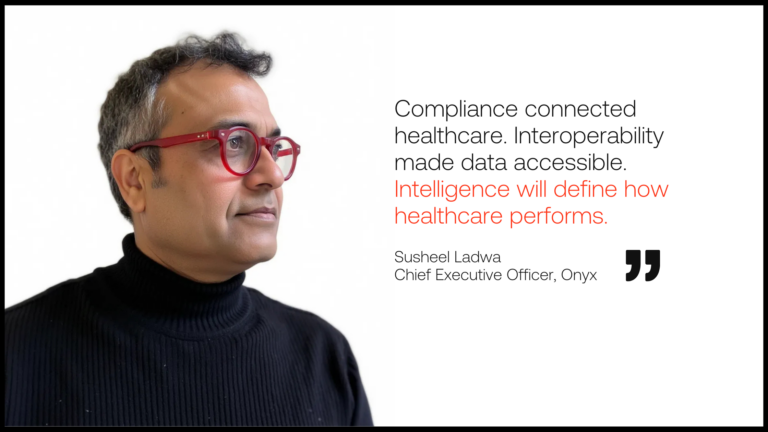
Compliance connected healthcare.
Interoperability made data accessible.
Intelligence will define how healthcare performs.
We will be discussing this evolution at HIMSS with organizations navigating the same transition.
Booth #3353 (InteropX, now Onyx) and FHIRBall Pavilion #249
March 9–12, Las Vegas
Request a meeting: https://www.onyxhealth.io/contact/