
What payer teams encounter once real data and scale are introduced
By Balaji Narayanan, Chief Product Officer, Onyx
Payer-to-Payer Data Exchange is a CMS-0057 workflow designed to transfer clinical history between payers when members change health plans. When executed reliably at scale, it establishes consistent data movement and enables downstream use across quality, utilization management, and risk programs.
In practice, Payer-to-Payer is one of the first CMS-0057 workflows where production conditions fully surface. Data variability, member matching outcomes, consent requirements, and operational scale all converge here, making it an early test of whether an interoperability approach is designed to function reliably over time.
What Payer-to-Payer Enables in Production
At a systems level, Payer-to-Payer ensures that clinical history follows the member across coverage changes and arrives in a form downstream systems can actually consume.
When this exchange operates predictably:
- Member onboarding workflows begin with more complete clinical context
- Care transitions rely less on manual data retrieval
- Delays that impact quality measurement and the member experience are reduced
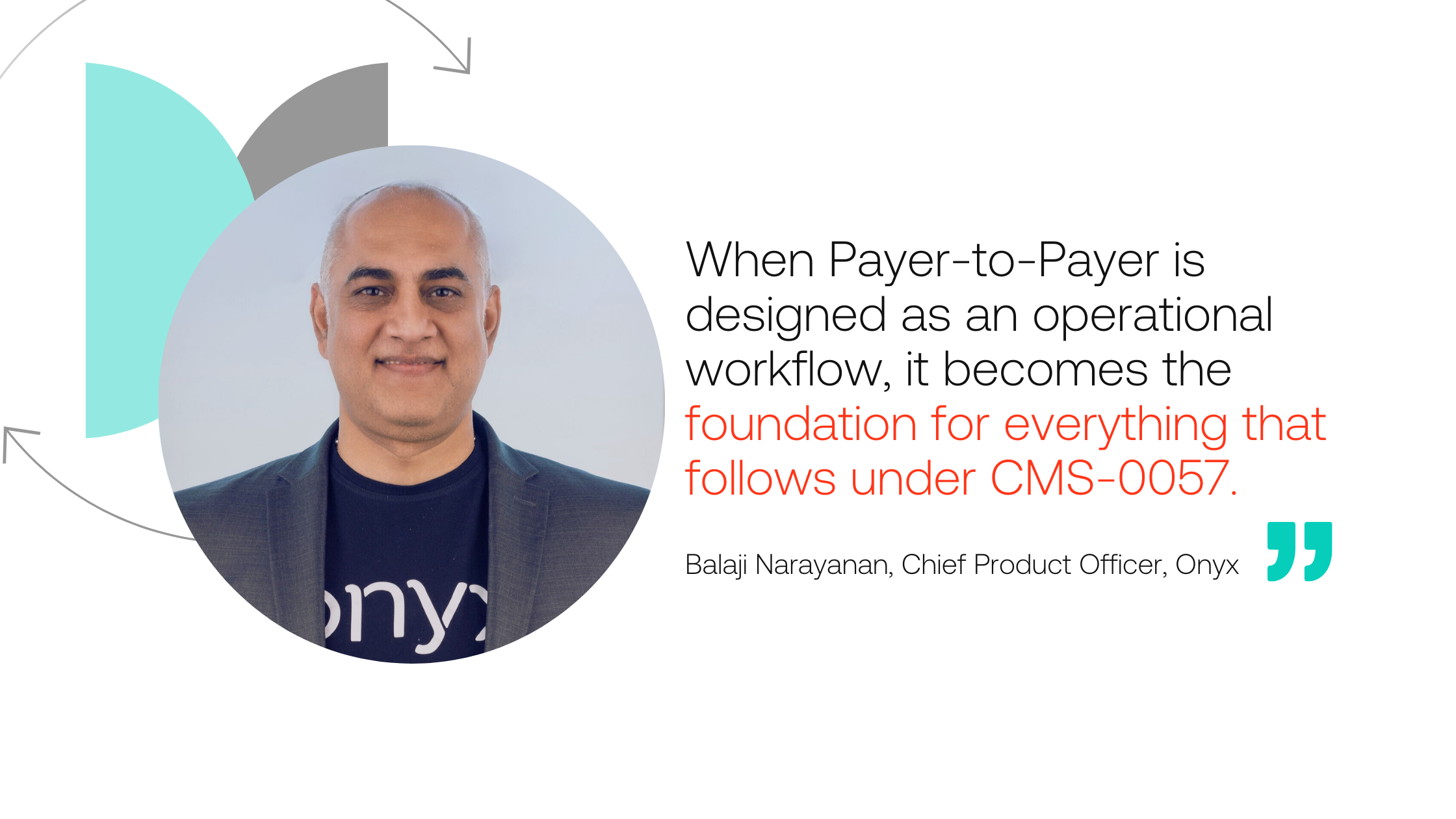
These outcomes depend less on specification compliance and more on whether workflows consistently produce usable data under real-world conditions. Teams that achieve these outcomes treat Payer-to-Payer as an operational workflow, with defined matching logic, consistent consent handling, and scalable export and ingestion processes, rather than as a one-time integration.
Where Payer-to-Payer Breaks Down
Most Payer-to-Payer implementations do not fail because the specification is unclear. They fail when assumptions made during design are stressed by production reality.
Common failure points include:
- Inconsistent source data across payer systems
- Mixed member match outcomes that are not handled explicitly
- Consent logic that varies by scenario
- Export and ingestion processes that do not scale predictably
At low volume, these issues may appear manageable. At scale, they introduce manual intervention, reprocessing, and operational risk. The result is an exchange that technically functions but cannot be relied on operationally.
In contrast, successful implementations address these conditions upfront by designing for mixed outcomes, enforcing consistent consent logic, and validating performance at expected production volumes before go-live.
Payer-to-Payer as the CMS-0057 Control Point
Payer-to-Payer is not an isolated requirement. It establishes the operational patterns that other CMS-0057 workflows inherit.
Decisions made in this workflow influence:
- How data is validated and normalized
- Whether exchanges are observable and repeatable
- How exceptions are handled without breaking flow
- Whether downstream systems can assume data readiness
Provider Access, Patient Access, and related CMS-0057 workflows depend on these same foundations. If Payer-to-Payer is brittle, downstream workflows inherit that brittleness.
From Reliable Exchange to Payer Operations
Exchange alone does not create value. Usable data does.
When claims and clinical data are unified and delivered reliably, payer teams can apply that data across core operational programs, including:
- Quality measurement and reporting
- Utilization management workflows
- Risk adjustment processes
- Care management and care delivery support
At this stage, automation and AI can be applied meaningfully — not to fix broken exchange, but to reduce manual effort, support prioritization, and enable more consistent decision-making across operational workflows. This depends on having claims and clinical data that arrive reliably and in a usable state; AI cannot compensate for incomplete or inconsistent exchange.
What This Means in Practice
For most teams, the challenge is not implementing Payer-to-Payer, but ensuring it operates reliably once real data, variability, and production scale are introduced.
That assessment is difficult to make on paper. It requires understanding how matching, consent, export, and ingestion workflows behave together in production — and where manual effort or reprocessing is likely to emerge.
Without a reliable Payer-to-Payer foundation, teams often end up using automation and analytics defensively, rather than applying AI to improve efficiency and decision-making.
How Onyx Supports Payer-to-Payer Under CMS-0057
We’ve helped multiple payer teams successfully stand up Payer-to-Payer in production, and we’ve built practical resources based on those real-world implementations.
To go deeper, you can explore our Payer-to-Payer Product Demo Preview that highlights key parts of the workflow, along with a preview of our proprietary Implementation Playbook our step-by-step guide that helps teams plan, sequence, and run Payer-to-Payer reliably at scale.
If you’re just getting started with CMS-0057 or if you’re looking to validate your current approach, Onyx offers a complimentary CMS-0057 Readiness Check — an expert-led, one-week evaluation that benchmarks CMS-0057 progress and delivers a quantified readiness report with clear, actionable recommendations.
As CMS-0057 timelines approach, the difference between planning and production will matter more than ever.